Insights
4 Conversations You Should Be Having at Dell Tech World 2026


1. AI is everywhere, but where are you?
Chances are if you were to throw one of the free stress balls you got at a convention booth it would land by someone talking about artificial intelligence. That really comes as no surprise: AI is one of the hottest topics for organizations this year, and a focal point of discussion at Dell Tech World. Rightfully so: many organizations are looking to adopt, implement, plan around, or leverage AI tools in some meaningful way.
But the conversations, much like the tools themselves, are as vast as they are deep. How are organizations handling their adoption? What have they considered for their end users, infrastructure, security, and data pipelines? Most importantly, where are their blind spots?
What better place to ask these questions and have these discussions than Dell Tech World? With AI taking center stage (figurative and literally), having real discussions about AI initiatives for your organization should be a top priority.
If you’re not sure where to start, there are two good focus areas you could use to get the ball rolling. First, physical and computer demand for AI. That includes scalability with computing power, GPUs, and securing your data pipelines. Second, governance and operations. Specifically, AI governance and cognitive architecture, data locality and storage, and finally the operational complexity your environment exists in today. Zero in on your organization and discuss not only what AI can do for it, but how AI will exist within it and how you’ll manage and strategize for this tool.
2. Keeping security top-of-mind with identity driven cybersecurity
Knowing who is accessing your organization’s systems and keeping that access secure isn’t new news for anyone, but the conversation has evolved quickly in the past year. The advent of artificial intelligence tools has changed who and what are authorized to be in your organization’s internal resources, and an ever-growing list of both company-issued and personal devices that end users will utilize make identity security complex and ever-scaling. In fact, a 2025 report from CyberArk estimates that for every one human identity in use, there are an average of 82 devices within an organizational environment. That ratio is likely to continue growing.
So, you know you need your identity security to scale, and you likely know that threats such as ransomware and similar threats are table stakes when it comes to identity security. The conversations that you should be having are ‘how are bad actors finding weak points in 2026’ and ‘what can I do to continue being preventative and prescriptive in my defense?’
Discuss where your security infrastructure is at in your organization today. Security should span firmware, hardware, and supply chain, as well as end users. Learn how organizations are prepping against more sophisticated social engineering attacks, as well as malevolent AI threats that could puncture your security in ways you hadn’t previously considered.
Most importantly, have conversations about the way professionals are planning their security through new technology adoption. Dell, for example, recommends a secure-by-design infrastructure approach. This approach identifies the vulnerabilities and threats on day 0, helping ensure security from the ground up, as well as looking at current infrastructures in place and making recommended adoptions and adjustments to meet ever-evolving identity security needs.
3. Optimizing cloud costs
More organizations are looking at either full cloud or hybrid cloud infrastructure solutions for their organization to help address a bundle of needs. Application access, communication, collaboration, information and file sharing, and data storage are just the tip of the iceberg for benefits that cloud environments can offer. And many of these have a common denominator: cost benefits.
Cloud environments were initially embraced for their cost benefits. But in 2026, organizations must ask a bigger question: are they maximizing the strategic value of their cloud investments, or simply accumulating redundant spend and underleveraged capabilities?
Many organizations are now re-evaluating their cloud environments, recalibrating the usage between public, hybrid, and on-prem to see opportunities for efficiency and cost reduction. It’s not only about saving money, it’s about making use of what you’re paying for and getting the most efficiency out of what you have in place.
Additionally, conversations are taking place around cost transparency. It’s not about how much you’re spending or saving, but where that money is going and how clearly defined that is. Nobody likes realizing they’re paying for something they aren’t using, that’s a given. But paying for something only to find out there’s additional costs for things that you’re not even aware of? Even worse.
Cost clarity is the name of the game, and cloud environments are a key focus – and discussion – every organization should be having internally and with technology partners.
4. Evolving and growing the IT skills and workforce in your organization
Technology evolves, and the way organizations use it evolves alongside it. Artificial intelligence is a prime example today. As innovation accelerates, organizations must evolve their workforce by identifying emerging roles and developing the skills needed to support them.
IT teams are smaller than before, but responsible for so much more. Getting them the right trainings to develop the right skills is crucial to ensure that they can make the most of new technology and tools, while at the same time ensuring the tools you’re adopting (like AI tools) are a value-add to your organization and end users. Positioning the technology for success is only half the battle – you need to plan and develop your workforce to meet these new resources and leverage them effectively.
At the same time, you want to reduce burnout and fatigue. Simplicity and automation help with that. Simplicity is easier said than done and requires a deep understanding of how your organization functions from a workforce and technology standpoint. Having an effective technology partner, one that can understand these two sides and how they work in harmony, goes a long way. Finding automations for areas that help free up your workforce ensures remedial tasks get done without taking away from more complex, demanding, and thought-intensive workflows that require knowledge and expertise from your organization’s teams.
Having conversations around the ‘how’ of all this is crucial right now. How does this get done? How does someone get started? How does someone find a partner? Dell Tech World is a great place to start those conversations, find those partners, and begin looking for ways to grow and enhance your organization’s workforce.
As the next few days at Dell Tech World unfold and these conversations continue to come up, try to think about where your organization is with each one. What is your organization's perspective on using AI? What is your cloud strategy looking like over the next five years? Are you getting the savings you should be from your technology, or are there possible blind spots you need help seeing? With so many experts in the same place, this is a great time to have these discussions and gain new perspectives.
The Redesign Group is thrilled to be attending this event. If you would like to talk with us either at Dell Tech World or in the future, be sure to reach out. We'd be more than happy to discuss any of the above with you, and more.
5 Quick Wins to Stabilize Your IT Environment in 30/60/90 Days
Days 0–30: Stabilize and See
Quick Win 1: Establish a clean baseline and real-time visibility
Goal: Get to a defensible baseline so you can triage faster and roll back safely.
How to get started (this week)
- Inventory & map: Export device lists from your switching, routing, wireless, firewalls, VPN, and WAN edge. Normalize names and tags by site/role.
- Time sync & logging: Enforce NTP on all devices; forward syslog/NetFlow/IPFIX to a central collector.
- Backups: Turn on nightly configuration backups with automated restore tests on a small pilot, then expand.
- Health dashboards: Stand up a single pane showing device health, link status, top talkers, and failed backups.
What to look for
- Gaps in device/site coverage, noisy or missing telemetry, inconsistent timestamps, unmanaged config drift.
Success signals
- Consistent, time-aligned logs across domains; low duplicate/unknown devices; stable traffic baselines by site/segment.
Key metrics (track weekly)
- Monitoring coverage: % of network/security devices sending health, syslog, and flow/telemetry.
- Backup posture: % of devices with verified nightly config backups and a successful test restore in the last 7 days.
- Alert hygiene: Signal-to-noise ratio (actionable vs. total alerts), false-positive rate.
- MTTD/MTTR: Mean time to detection/resolution for P1/P2 incidents.
Targets by Day 30
- ≥ 95% device coverage (core, edge, wireless, firewalls).
- Nightly, verified config backups on ≥ 90% of devices.
- ~25% alert-noise reduction.
- ≥ 20% MTTD improvement vs. baseline.
Where Cisco can accelerate
- Cisco Meraki Dashboard or Cisco Catalyst Center for unified visibility and inventory.
- ThousandEyes for path/SaaS visibility to isolate app vs. network issues.
- SecureX for cross-domain correlation.
Outcome: Fewer surprises, faster triage, and a defensible baseline for the next phases.
Quick Win 2: Reduce avoidable outages with patching & access hardening
Goal: Eliminate the biggest, most fixable risks without disrupting the business.
How to get started (this week)
- Patch snapshot: Pull firmware/OS versions for core, edge, WLCs, VPN, firewalls. Tag critical gaps (vendor advisories/CVEs).
- Change window: Book a recurring weekly window; patch a small ring first, then expand.
- Admin controls: Require MFA for all admin and remote access; remove shared accounts; enforce least-privilege RBAC.
- Service accounts: Audit stale or over-privileged service accounts; rotate secrets.
What to look for
- Deferred critical updates, inconsistent OS levels, missing MFA, spikes in failed privileged logins.
Success signals
- High patch compliance on critical infrastructure; universal MFA for admins; stable change windows.
Key metrics
- Patch/firmware compliance: % of critical infrastructure on vendor-recommended versions.
- MFA coverage: % of privileged/remote sessions with MFA enforced.
- Privileged auth health: Failed admin login rate; lockouts; anomalous access attempts.
- Change health: Change success rate; unplanned downtime tied to patching.
Targets by Day 30
- 100% remediation of known critical vulns on core/edge/VPN/WLCs.
- 100% MFA for admin and remote access.
- ≥ 30% reduction in failed privileged logins.
- Zero outages attributable to known, unpatched vulnerabilities.
Where Cisco can accelerate
- Cisco Duo for quick, user-friendly MFA.
- Cisco Secure Firewall best-practice policies for hardened access.
- Meraki templates to propagate consistent security settings.
Outcome: Immediate risk reduction with minimal disruption.
Days 31–60: Optimize and Layer Security

Quick Win 3: Standardize configurations & prioritize business traffic
Goal: Improve user experience and simplify ops with consistent configs and QoS.
How to get started (this month)
- Role-based templates: Define templates for core/aggregation/access/WLAN/edge: VLANs, routing, NTP, AAA, logging.
- QoS policies: Identify business-critical apps (voice/video/UC, ERP, EHR). Mark and police to targets; verify end-to-end.
- Segmentation: Create clear segments for guest, IoT, OT, and corporate; tighten ACLs between them.
- Drift control: Enable compliance checks and alerts on template deviation.
What to look for
- Config drift across core services; missing QoS markings; flat networks without segmentation.
Success signals
- High template compliance; clean segmentation boundaries; reduced jitter/packet loss during peak hours.
Key metrics
- Template compliance: % of devices aligned to role-based standards.
- App experience: Latency, packet loss, jitter for top business apps and collaboration.
- Policy efficacy: Hit-to-miss ratio on top ACL/firewall rules; shadowed/redundant rules count.
- Change reliability: Change success rate; post-change incident rate.
Targets by Day 60
- ≥ 90% template compliance for targeted groups.
- Real-time traffic jitter < 30 ms; packet loss < 1%.
- ≥ 95% change success rate.
- ≥ 80% hit ratio on top rules; remove/merge redundant rules.
Where Cisco can accelerate
- Catalyst Center for intent-based templates & compliance.
- Meraki configuration templates for rapid standardization.
- Secure Firewall analytics to flag rule cleanup opportunities.
Outcome: Smoother performance, cleaner change windows, less fire-fighting.
Quick Win 4: Add lightweight security layers that stop threats earlier
Goal: Move defense upstream (DNS, remote access, access control) without slowing users.
How to get started (this month)
- DNS protection: Force all egress DNS through a protected resolver; block direct-to-internet DNS.
- Remote access posture: Enforce MFA and basic posture checks (OS version, AV running) for VPN users.
- Access control pilot: Start 802.1X on a low-risk segment (e.g., guest/IoT) with MAC exceptions as needed.
- Containment runbook: Document steps to isolate a host within minutes (who, how, tools) and rehearse once.
What to look for
- Unprotected DNS, inconsistent VPN posture, gaps in MFA adoption, recurring phishing clicks, slow endpoint containment.
Success signals
- High DNS block efficacy with low false positives; posture checks enforced; rapid isolate/contain workflows.
Key metrics
- DNS defense: Malicious domain block rate/volume; % of egress using protected DNS.
- Remote access posture: VPN MFA adoption; posture check pass rate.
- User resilience: Phishing click-through rate; report rate.
- Response speed: Endpoint containment time; detection-to-isolation interval.
Targets by Day 60
- 100% egress protected by DNS-layer security.
- ≥ 95% VPN MFA adoption; posture checks on risky endpoints.
- 30–50% reduction in phishing click-through.
- Endpoint containment < 30 minutes for high-severity events.
Where Cisco can accelerate
- Cisco Umbrella (DNS-layer defense).
- Secure Client + Duo for secure, seamless remote access.
- Identity Services Engine (ISE) pilots for 802.1X and device profiling.
Outcome: Fewer incidents reaching endpoints and faster, more confident response.
Days 61–90: Prove Value and Right-Size Spend
Quick Win 5: Publish an executive scorecard and capture savings
Goal: Translate ops wins into business proof points and fund what works.
How to get started (this month)
- Define the scorecard: Agree on 1–2 KPIs per pillar—Service Health, Experience, Financial, Operations—with clear owners.
- Automate data pulls: Connect your monitoring/ITSM/export jobs to refresh weekly (CSV/API).
- Savings scan: Identify overlapping tools, idle licenses, under-utilized circuits; map removal plan and dates.
- Runbooks & drills: Document top 5 incident runbooks; conduct one tabletop + one live “fire drill.”
What to look for
- Downward incident trends; stable/improving SLAs; measurable user experience gains; visible cost takeout with verified decommissions.
Success signals
- Leadership can see trends at a glance; finance validates realized (not just projected) savings; fewer tickets per 100 users.
Key metrics
- Service health: MTTR; incident rate trend; SLA adherence for critical services.
- Experience: Latency/jitter trends for key apps; tickets per 100 users; CSAT or resolution-sentiment.
- Financial: Circuit/license utilization; overlapping tools removed; maintenance/renewal savings; cost avoided.
- Operations: Runbooks completed; fire-drill pass rate; adherence to quarterly review cadence.
Targets by Day 90
- Publish a baselined executive scorecard with automated weekly refresh.
- ≥ 25% MTTR reduction vs. Day-0 baseline.
- ≥ 99.9% SLA adherence on critical services.
- ~10–15% fewer support tickets per 100 users.
- 10–15% savings from tool consolidation/right-sized licensing; decommission ≥ 1 legacy tool or circuit.
- Secure approval/funding for the next 90-day plan.
Where Cisco can accelerate
- Meraki & Catalyst telemetry for usage-based right-sizing and executive reporting.
- Platform consolidation (licensing/policy) across Cisco solutions to reduce overlap and operating cost.
Outcome: Clear proof of performance gains and cost control that builds confidence and momentum.
How The Redesign Group Helps You Move Faster
The Redesign Group delivers value with velocity through a lifecycle approach, assess, design, implement, manage. As a Cisco-focused solutions partner with nationwide reach and deep networking/security expertise, we bring proven playbooks, reference architectures, and automation that compress timelines and reduce risk. Whether you need a rapid health check, a Meraki or Catalyst optimization, or help operationalizing security layers, our team meets you where you are and gets you to measurable outcomes fast.
Next Step
Get the full 30/60/90-day plan inside the “Give Your Network a Redesign” guidebook.
Download the guidebook or request a network & security assessment to jump-start your roadmap.

Why Enterprise Networks Struggle Today; How Redesign & Cisco Close the Gaps
1) Modern network complexity is outpacing operational models
Today’s environments span data centers, multiple public clouds, branch sites, home offices, and thousands of SaaS apps. That breadth creates inconsistent user experiences and operational strain because traditional change, troubleshooting, and governance models were not designed for this level of dynamism.
- Multicloud routing and policy inconsistency: When policies are defined differently across on‑prem and cloud networks, traffic can take unpredictable paths and violate intended controls, leading to uneven performance and security coverage.
- Identity sprawl across services: Multiple identity providers and legacy directories make it harder to enforce least privilege and track who has access to what, increasing risk and administrative overhead.
- East‑west traffic growth with limited segmentation: As applications decompose into services, lateral movement increases. Without consistent segmentation, a single compromise can spread faster and further.
- Remote work variability: Home networks and variable ISPs introduce jitter and packet loss, complicating performance assurance and making root cause analysis more time‑consuming.
- Shadow IT from unsanctioned SaaS: Teams adopt tools to move quickly, but unsanctioned apps bypass standard controls, creating blind spots for data, identity, and network traffic.
The bottom line: complexity slows troubleshooting, makes changes riskier, and increases the likelihood of outages. Redesign helps standardize architectures and operational practices by leveraging Cisco’s validated designs, automation, and observability to align policies across data center, cloud, and edge so the network behaves predictably at scale.
2) Threats and compliance demands keep rising
Attackers exploit complexity. At the same time, regulatory frameworks continue to expand—especially in healthcare, retail, education, and state and local government—requiring tighter controls and continuous evidence of compliance.
- Ransomware, phishing, and supply‑chain attacks: Misconfigurations or inconsistent controls can dramatically increase blast radius, turning small errors into major incidents.
- Zero Trust ambitions that stall: Without unified identity, segmentation, and high‑fidelity telemetry, organizations struggle to move from intent to enforcement.
- Audit readiness gaps: Incomplete logging, asset inventories, and policy enforcement make it harder to prove control efficacy and respond to findings.
- Inconsistent security across sites and clouds: When controls aren’t uniformly deployed, adversaries find and exploit the seams between environments.
Security teams feel the squeeze: more risk to manage with the same or fewer resources. Redesign takes a practical, outcome-driven approach that harmonizes identity and policy, strengthens segmentation, and improves evidence collection, all built on Cisco’s security and networking platforms. Together, these capabilities help you advance Zero Trust and meet audits with confidence
3) Tool sprawl drives cost and operational drag
Years of point solutions add overlapping licenses, divergent data, and complex runbooks. The result is slower incident response and higher total cost of ownership without better outcomes.
- Multiple monitoring consoles with conflicting data: Teams lose time reconciling dashboards instead of resolving issues, delaying restoration and increasing MTTR.
- Underused features you already own: Capabilities that could simplify operations or improve security often sit idle because enablement and adoption lag procurement.
- Complex, brittle runbooks: Manual handoffs across tools create errors and slow down investigations and change windows.
- Higher TCO from fragmentation: Redundant platforms and contracts inflate spend and complicate renewals, while skills must stretch across too many vendors.
Consolidation with a Cisco‑powered architecture, guided by Redesign, streamlines operations and spend. We map use cases to platform capabilities, retire redundant tools, and implement automation so your teams get time back and your investments deliver measurable returns.

The downstream impact
These dynamics do not stay contained within IT. They ripple across the organization, affecting experience, risk, and speed.
- Performance: Unpredictable application experiences frustrate employees and customers, increasing support tickets and dragging productivity.
- Security: Inconsistent policies leave exploitable seams between environments, raising the likelihood and impact of incidents.
- Agility: Elevated change risk slows innovation and transformation, delaying projects that drive competitive advantage.
Addressing these issues holistically improves reliability and resiliency while creating a stronger foundation for modernization initiatives across the business.
Where to start: a Redesign Network & Security Assessment
Redesign begins every engagement with a consultative assessment to surface risks, quantify opportunities, and prioritize investments. It’s the fastest way to clarify your current state and establish a practical path forward, aligned to business outcomes and compliance obligations.
What the assessment uncovers
- Architecture clarity: We map your current state across data center, WAN/edge, remote access, and cloud to show dependencies, control points, and failure domains.
- Security posture: We evaluate identity and access, segmentation, encryption, and control coverage to highlight gaps and high‑value remediation steps.
- Observability gaps: We assess traffic visibility, telemetry consistency, and alert quality so you can detect, triage, and fix issues faster.
- Performance hot spots: We identify latency, congestion, and policy conflicts affecting critical apps and recommend targeted improvements.
- Tool consolidation opportunities: We pinpoint where Cisco‑powered architectures can replace overlapping point tools to cut cost and complexity.
By the end, you will understand what is working, what is not, and which changes will deliver the greatest impact with the least disruption.
Why Redesign + Cisco
Redesign is a global IT solutions provider delivering value with velocity across networking, security, data center, and managed services. Founded by former Dell EMC leaders and enterprise IT executives, we bring together deep Cisco expertise and the personalized care of a boutique partner. Our team now supports more than 1,300 customers across diverse industries.
- Cisco specialization: We apply validated architectures for secure, high‑performance connectivity across campus, branch, cloud, and data center.
- Lifecycle delivery: We assess, design, implement, and manage every solution in‑house to ensure accountability and consistency end‑to‑end.
- Measurable outcomes: We focus on simpler operations, stronger security, and scalable growth—backed by clear success criteria and operational handoffs.
With the agility of a boutique and the scale of a national integrator, Redesign sets a new standard for technology partnerships: agile, trusted, and relentlessly focused on outcomes.
Signs your network needs a redesign now
If one or more of these symptoms sound familiar, your network may be working against your goals rather than enabling them.
- MTTR is creeping up despite more tools: More dashboards are not translating into faster fixes, signaling data quality or process issues.
- Inconsistent app performance across locations: Users experience variability that points to policy misalignment, congested paths, or visibility gaps.
- Repeat audit findings: Year‑over‑year gaps indicate control inconsistency and missing evidence rather than isolated oversights.
- Remote access and SaaS performance swings: Day‑to‑day variability suggests optimization and telemetry deficiencies.
- Redundant platforms under separate contracts: Overlap drives cost and complexity that a consolidated architecture can eliminate.
Addressing these signals early prevents operational debt from compounding and restores confidence in the network as a strategic asset.
Make complexity work for you
The gap between what your network must deliver and what your team can operate won’t close on its own. A focused assessment provides the clarity and momentum to modernize with confidence—reducing risk while improving experience for every user, everywhere.
Next steps
Download the "Give Your Network a Redesign" guidebook to see how to overcome today’s IT challenges. To request an assessment or get more detail, visit the Redesign Network Assessment page.

CIS Controls Gap Analysis | Assess Your Cybersecurity Maturity with Redesign
Understanding Your Cybersecurity Maturity with CIS Controls v8.1
As cyber threats continue to escalate and regulatory expectations grow tighter, organizations are under increasing pressure to prove their cybersecurity maturity. The CIS Critical Security Controls (CIS Controls) framework provides a prioritized, risk-informed roadmap for strengthening defenses—rooted in real-world attack data and proven defensive practices.
At Redesign, we help companies assess how their current security posture aligns with the CIS Controls. A CIS gap analysis not only identifies where your security program is strong or lacking but also maps those insights into a clear, actionable roadmap for risk reduction and compliance readiness.
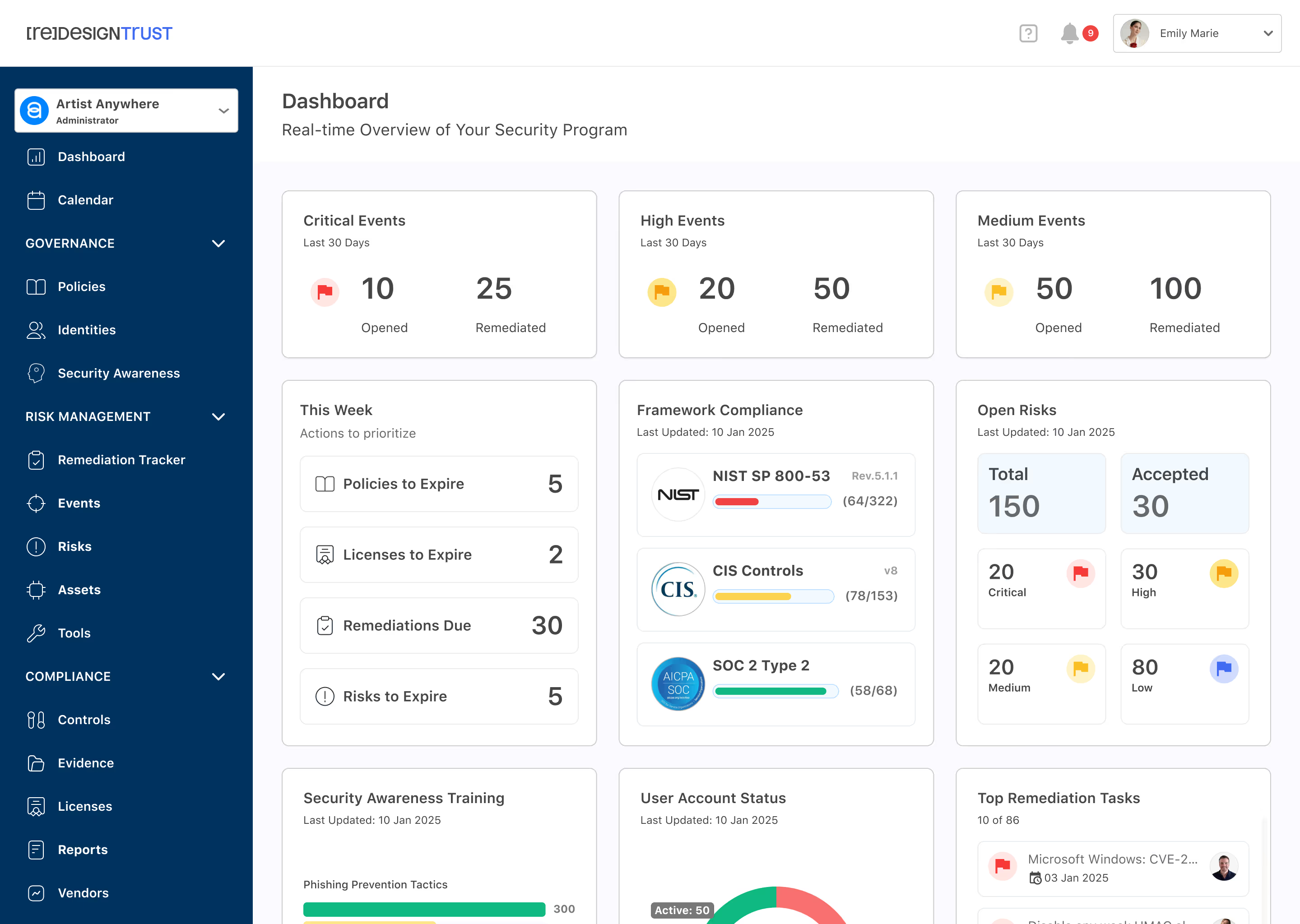
Accelerate your CIS Controls Gap Analysis with Redesign Trust Portal—a centralized platform that automates evidence collection, streamlines control tracking, and delivers real-time insights, making your compliance process faster, efficient, and more cost effective.
What Are the CIS Controls?
Developed by the Center for Internet Security (CIS), the CIS Controls are a set of 18 control families designed to address the most common and impactful cyber risks. Instead of spreading resources thin across hundreds of theoretical safeguards, CIS focuses on high-leverage practices such as:
- Inventory and Control of Enterprise Assets
- Access Control Management
- Continuous Vulnerability Management
- Security Awareness and Skills Training
Each control family is supported by detailed Safeguards, organized into Implementation Groups (IGs) that reflect organizational maturity:
- IG1 – Basic Cyber Hygiene: Foundational protections every organization should have in place.
- IG2 – Intermediate: Enhanced measures for organizations with moderate complexity and risk exposure.
- IG3 – Advanced: Comprehensive controls for enterprises managing high-value assets or operating in heavily regulated sectors.This tiered structure enables organizations to adopt controls at a realistic pace and maturity level.
Why Perform a CIS Gap Analysis?
A CIS gap analysis is far more than a checklist exercise. It’s a strategic assessment that connects technical implementation with business risk, allowing you to:
- Identify which controls you have in place and which are missing.
- Understand your maturity level across each Implementation Group.
- Prioritize remediation efforts based on real risk reduction potential.
- Benchmark against industry peers and compliance standards.
- Build a roadmap that strengthens security resilience and supports audit readiness.
At Redesign, our methodology blends technical validation, policy review, and risk context to produce a practical, prioritized roadmap—empowering leaders to invest where it matters most.
The Redesign Gap Analysis Process
Our CIS Controls gap analysis is a structured, collaborative engagement that includes:
- Discovery & Scoping – Identifying systems, processes, and data relevant to the CIS framework.
- Evidence Collection & Review – Analyzing existing policies, configurations, and security tools.
- Control Mapping & Assessment – Evaluating alignment with CIS Controls across IG1–IG3.
- Maturity Scoring – Quantifying your organization’s performance by domain and safeguard.
- Findings & Recommendations – Delivering a prioritized roadmap for remediation and improvement.
- Executive Summary & Presentation – Communicating results in a way that resonates with both technical and business audiences.
The result is a CIS-aligned cybersecurity maturity assessment—a foundation for ongoing improvement and regulatory compliance.
Partner with Redesign
Whether your goal is to strengthen your core security posture, meet compliance requirements, or prepare for a formal audit, Redesign helps you get there with confidence.
Our team of cybersecurity experts can guide your organization through a full CIS Controls gap analysis, map results to frameworks like NIST CSF 2.0 or SOC 2, and design a phased implementation roadmap that accelerates your security journey.
Ready to assess your cybersecurity maturity?
Contact us today to schedule a CIS Controls Gap Analysis with Redesign.
Discover where your defenses stand—and how to bridge the gaps that matter most.

Redesign Builds Hyperscaler Platform for Movie and TV Production
The Challenge
The content creation process has historically been fragmented across disparate phases of feature film, TV series, or animation projects. Each phase often includes different teams, locations, workflows, and storage infrastructure. As the digital technologies involved within the content creation process become more complex and ubiquitous, data growth has become unmanageable.
The department most impacted by the size and complexity of media storage requirements is Visual Effects. The Visual Effects teams have become the glue to bringing the creative vision of the Director to life. Reference material and metadata from pre-production and production is critical for maintaining creative context during the post-production enrichment process. The fragmented approach to managing metadata and files requires a significant amount of data management, manual handoffs, and invariable human error, leading to loss of context. This loss of context impacts downstream post-production processes, making it more time-consuming and costly to produce creative content.
Additionally, the Media & Entertainment industry has established a new baseline of content spend, rising from 371 original content releases in 2019 to over 1,300 content releases in 2022. That number is expected to remain consistent, with over $125B in content spend projected for 2023. This places a heavy burden on a supply chain that’s already operating at capacity. There simply aren’t enough people to maintain the new baseline without the help of technology innovations.
The [RE]DESIGN Group recognized the need for innovation in the form of workflow automation and tapping into the future potential of Artificial Intelligence capabilities. The Artist Anywhere platform was created to connect the fragmented phases of the content creation supply chain into a common data hub, where critical metadata and reference material could be made available to globally dispersed teams in real-time.
To enable automation and eventually take advantage of AI, Redesign needed to first solve the problem of capturing all the data into a common repository. The Artist Anywhere cloud platform provides a high-performance filesystem that’s accessible for remote users, Onset data capture teams, editorial and VFX teams, and the ability to localize files at the edge for 4k reviews. The platform maintains real-time access to metadata and files regardless of user location.
In addition, Artist Anywhere is a Production Tracking pipeline that leverages the Autodesk Shotgrid database and Artist Anywhere’s Studio Workflow Suite of tools, enabling VFX crew members to automate many time-intensive data management tasks, so they can work better and work faster.
Artist Anywhere deploys a complete production pipeline for VFX teams, including multifactor authentication, remote access to virtual and physical workstations optimized for creative applications, high performance storage, data protection, a cloud-based delivery system with a transfer application for worldwide vendors, a suite of automation tools, and a real-time data fabric that connects users at the edge or cloud, enabling line-speed access to all files.
The initial launch of the Artist Anywhere platform was built using commodity hardware, virtualization technologies, and manual deployments. As the platform grew to support dozens of simultaneous projects with several hundred VFX users, the ability to compose new virtual or physical workstation profiles—or to modify workstation configurations in real-time based on user feedback—became critical.
To address these shortcomings, the Redesign team launched a project to build an entirely new, flexible platform that would allow pools of resources such as CPUs, GPUs, and SAS storage to be dynamically assigned to virtual machines as needed. This allowed the Artist Anywhere cloud platform to meet peak performance requirements, rapidly onboard new users, and better adapt to invariable hardware failures.
Solution
After significant research and testing, Redesign’s solution architecture team designed a new platform, dubbed the Hyperscaler Appliance. The Hyperscaler is a completely integrated appliance which includes Dell networking, Dell servers, a Mellanox RDMA fabric with Vcinity RAD-X services for RDMA over WAN, highly performant SAS storage, and pools of GPUs connected using Liqid’s Matrix Composable Disaggregated Infrastructure (CDI) software.
The Hyperscaler includes virtual deployments of WekaIO software for workstation storage and Pixit Media software for primary production storage. The appliance includes the multi-tenant Artist Anywhere Production Portal for onboarding and offboarding users to cloud workstations across any cloud provider or workstation virtualization technology.
It also runs Redesign’s queuing system which integrates with S3 archival storage for data protection and archiving. The queuing system ensures that the folder and file structure from production is emulated within the customer’s cloud archive environment and also provides pipeline visibility into the global namespace.
The composable infrastructure capability with Liqid offers benefits both in terms of workload management and resiliency, ensuring clients continue to experience the performance they expect while dramatically reducing the time IT invests in managing resources. Redesign can dynamically assign GPUs to servers and client workstations as business requirements dictate.
The Hyperscaler configuration can support up to 30 to 40 GPUs per fabric, giving the Artist Anywhere platform the flexibility to deploy four times their previous limit of five GPUs per conventional server chassis. This also enables future AI use cases that can be extended to major studios and their production teams, by integrating metadata and reference material with language models and creative applications.
To provide fault tolerance against a NAS gateway failure interrupting production, a storage HBA is composed into the NAS gateway server. In the event of a hardware failure, client VMs with both storage and GPU capacity can be reassigned to a different Hyperscaler platform, ensuring customers continue their work uninterrupted.
“When designing a modern High Performance Computing (HPC) platform, it’s critical to ensure that every component of your architecture acts as an enabler to workflow, automation and AI,” according to Joe Sanginario, founder of The Redesign Group.
“In the past, technology decisions and solutions have often been made within organizational silos that were unaware of the constraints that those decisions introduced at the pipeline layer. We’ve shattered those constraints by designing a true hyper-converged pipeline. Data access is extensible and in real- time. This is not S3 syncing, this is efficient RDMA access that doesn’t require any computing overhead. Our infrastructure is pipeline aware, meaning we can query metadata instantly and build pipeline automation tools that enable users to manage workflow rather than files. This is built with commodity components, in the smallest form factor, yet abstracted into software for composability. That is pipeline flexibility that can solve today’s toughest data management challenges while maintaining an innovation lifecycle for whatever comes next.”
In addition to offering the Hyperscaler platform as a service with the Artist Anywhere Cloud, Redesign also sells the Hyperscaler platform to HPC customers that prefer to build their own internal multi-tenant cloud capabilities.
The Benefits
The Hyperscaler platform with composable GPUs and storage HBAs also simplifies the scoping process for onboarding new clients. “We can confidently purchase commodity infrastructure and configure those components to achieve any desired workflow outcome for our users.
“With the Hyperscaler platform, we’re able to scale our business more easily and rapidly. The lead time for on-boarding new clients has been dramatically reduced. We’ve cut our public cloud costs in half by hosting most of our data and compute requirements internally, and we’re pleased to offer a more resilient platform that can maintain productivity for our users.” said Sanginario.
About Liqid
LIQID Inc.’s composable infrastructure software platform, Liqid Matrix TM, unlocks cloud-like speed and flexibility plus higher efficiency from on-prem infrastructure. Now IT professionals can configure, deploy, and scale physical, bare-metal servers in seconds, then reallocate valuable accelerator and storage resources via software as needs evolve.
Dynamically provision previously impossible systems or scale existing investments, and then redeploy resources where needed in real-time. Unlock cloud-like datacenter agility at any scale and experience new levels of resource and operational efficiency with Liqid.

Elevate Your Security Standards
In early 2023, the Motion Pictures Association (MPA) released the latest version of their Content Security Best Practice Controls, alongside a new web platform ‘TPN+’ for vendors and assessors to store their security status and assessment outcomes as structured data. This data is available to studio content owners to support risk based decision making when choosing vendors.
If you wish to work with the main media and entertainment industry content owners, then being assessed against the MPA content security best practice controls using the TPN+ portal gives these content owners insight into your current security posture, and helpfully informs your conversations about prioritization and justification of security investments.
Whether you would like an informal chat to discuss how to approach industry security controls, require a full suite of security services including gap analysis of current state, vulnerability scanning, penetration testing, security policy development and network engineering support, or whether you just require the TPN Gold Shield assessment from a qualified Site or Cloud TPN assessor, Redesign are here to help with any and all of the above.

Redesign has become an official member of the CIS SecureSuite
Redesign has become an official member of the Center for Internet Security (CIS) SecureSuite. This means REDESIGN is now part of a selected group of companies that can utilize the CIS Controls framework to help companies build and manage their cybersecurity program against industry best practices.
The CIS harnesses the power of the global IT community to safeguard public and private organizations against cyber threats. The CIS Critical Security Controls (CIS Controls) are a prioritized set of Safeguards to mitigate the most prevalent cyber-attacks against systems and networks. They are mapped to and referenced by multiple legal, regulatory, and policy frameworks. CIS Controls v8 has been enhanced to keep up with modern systems and software. Movement to cloud-based computing, virtualization, mobility, outsourcing, work-from-home, and changing attacker tactics prompted the update and supports an enterprise’s security as they move to both fully cloud and hybrid environments.
Redesign Trust helps customers build and demonstrate their Essential Cyber Hygiene to the CIS Critical Security Controls Framework. Contact us to learn more about our cybersecurity service offerings:
- Rapid Risk Assessment against the CIS Critical Security Controls Framework
- Managed Security Services (MSSP)
- Cybersecurity Solution Design & Implementation through our Strategic Partnerships

TPN Expanded Best Practices Guidelines
The Motion Pictures Association’s Trusted Partner Network (TPN) has announced it is expanding its security best practices for cloud workflows. The TPN is the leading film and television content security initiative and provides a framework of best practices to help organizations secure their content.
Over the next 12 months, the TPN will roll out a new enhanced program that will include: guidelines for securing cloud workflows; a simplified onboarding process for TPN assessors; an enhanced “Gold Assessment Program”; and a new “Blue Self-Attestation Program” to provide vendors with the ability to report alternate security certifications. “TPN is growing to keep pace with an industry where security threats are more insidious and sophisticated, and work in the cloud has become the new norm,” said TPN President Terri Davies.
“Our expanded program will embrace all the ways work gets done in our industry today while growing capacity, making it easier for service providers to ensure they are meeting security benchmarks and for content owners to make more informed independent vendor selections from a more accessible and centralized solution.”
Coming this fall, the TPN will publish expanded best practice guidelines covering application, site and cloud workflows. These new guidelines will be used to develop the TPN’s Gold Assessment Program and Blue Self-Attestation Program which are both scheduled to be released in Q1 2023. This Gold program will enable vendors to measure and report conformity to the industry’s most recognized standards. The Blue program will provide a flexible framework for vendors to self-attest and report compliance with various alternate security control sets such as CIS Controls, NIST and ISO.
The program will serve as a single-source-of-truth for security information and is intended to reduce the need for organizations to have to undergo multiple vendor audits. Redesign Trust is uniquely positioned to advise its media and entertainment customers on these new application, site, and cloud security requirements and provide them cost-effective and scalable solutions to maintain compliance to the TPN’s evolving best practices. Through our strategic partnerships with industry leading cybersecurity firms, Redesign Trust also provides Managed Security Services to enable customers to leverage our cybersecurity expertise to manage the ongoing security program activities on their behalf in a cost-effective subscription model.






.avif)